Pottery & Artifacts
Southwestern pottery types, color by period
A Southwestern sherd is a dated letter from a vanished kitchen. Learn the color system behind the type names and every museum case, ruin trail and excavation report in the region opens like a book.
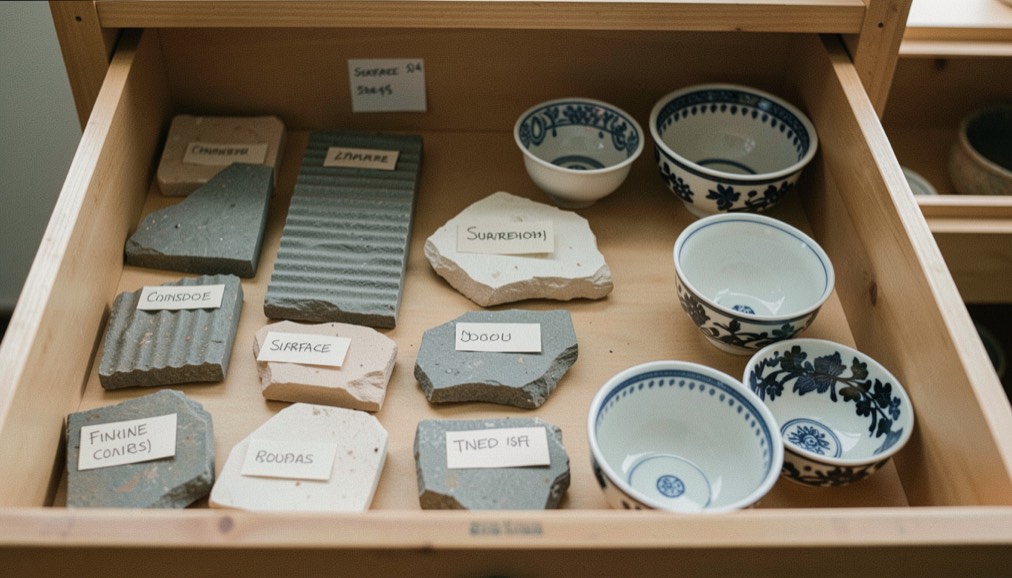
North American archaeology was built on Southwestern potsherds, and for a practical reason: pottery here changed fast, broke often and stayed put. From roughly the first centuries CE until today, potters across the region kept reinventing surfaces, and a century of typological work turned those surfaces into names, and the names into dates. The system looks forbidding, with compounds like Tsegi Orange Ware and Roosevelt Red Wares, but it runs on one simple observation: the Southwest's decoration is almost a color code, and the colors march through time.
How a type gets its name
A pottery type is a repeatable recipe, not a casual description. Analysts define it by paste, the clay body; by temper, the crushed rock, sand or sherd grit mixed in to control shrinkage; by surface treatment, plain, corrugated, slipped or polished; and by paint, its color and chemistry, mineral or plant based. The name then follows a convention: place of origin plus surface plus color, so that Mesa Verde Black-on-white names white slipped bowls painted black in the Mesa Verde tradition. Types are grouped into wares, the color families, and wares into traditions, so the taxonomy mirrors the cultural map drawn in our guide to the Southwest's four traditions.
The color code, period by period
| Ware | Look | Main period | Homeland and notes |
|---|---|---|---|
| Gray utility ware | plain and corrugated gray jars | Basketmaker III onward | Plateau wide, cooking pots, the workhorse of every village |
| White ware, black-on-white | white slip, black painted lines | about 700 to 1300s | Chaco, Mesa Verde and northern traditions; the classic Puebloan fine ware |
| Orange ware | orange slip, black or red paint | about 800 to 1400s | Hopi country and the Tsegi, precursors of Jeddito yellow ware |
| Jeddito yellow ware | hard smooth yellow paste | about 1300 onward | Hopi, fired with coal, traded far; a hallmark of Pueblo IV |
| Mimbres black-on-white | bold figural painting | about 1000 to 1130 | Mogollon Mimbres branch, the famous painted bowls |
| Salado polychrome | red, white and black together | about 1275 to 1400 | spreads across the Southwest in the 1300s, style and religion moving together |
| Rio Grande glaze ware | glaze painted red ware bowls | about 1300 to 1700s | Pueblo IV towns, seriated so finely it dates sites to decades |
| Hohokam buff ware | buff paste, red painted designs | about 500 to 1450 | Salt and Gila deserts, the desert Southwest's own sequence |
Read the table as a clock. A trash layer with corrugated gray and early black-on-white belongs to the Pueblo II world of Chaco; one with Jeddito yellow and glaze red belongs to the Pueblo IV world after the migrations. This is how the Pecos periods get their dates on the ground, cross checked against tree rings.
What the pots were for
The decorative wares get the glory, but the corrugated cooking jar is the more intimate fossil. Corrugation, coils left indented on the exterior, is not decoration; it increases surface area and strength for pots set directly in cooking fires, and its texture changed in small measurable ways decade by decade, which is why archaeologists can seriate gray utility ware almost as finely as painted ware. Bowls for serving, ollas for storage and water, canteens for travel and ladles for the serving line each had their moment and their shape fashions. Form follows hearth in this region, and the hearth is where the people were.
A checklist for reading pottery in a museum case
- Name the ware first by color of paste and slip, before you read the label, then check yourself.
- Find the temper in the broken cross section if the display shows one, and note how coarse it is.
- Look at line weight and brush confidence; they change by period as surely as hemlines did.
- Check where the type was made and how far it traveled, and ask who wanted it and why.
- Finish with the contemporary case, because Hopi, Zuni, Acoma and Rio Grande potters continue every one of these lineages today.
Mistakes to avoid with type names
Do not use type names as tribal names; "Mesa Verde Black-on-white" names a ceramic recipe, not a people, and its makers were the ancestors of several modern communities. Do not assume fine decoration means high status in every case; much painted ware was everyday tableware. Do not date a site from a single sherd in isolation, since types overlap and heirlooms travel. Do not confuse Mimbres bowls with Puebloan white ware despite the shared colors; the tradition, paste and history are Mogollon, a distinction our traditions guide keeps clear. And do not buy pottery that is advertised as prehistoric or "museum grade old"; the legal market is contemporary made work, and the rules are in our artifacts and museums guide.
The decision this knowledge buys
Learn the color code once and you gain three powers for the price of one table: you can date a ruin from a single lawful glance at its exhibit cases, you can follow trade and migration across the map as styles spread, and you can stand in a Pueblo pottery shop today and recognize the thousand year choices in a living artist's work. Take the primer to a museum, take the checklist to the next case, and let the pots, which never lie about their period, do the talking.