Pottery & Artifacts
A sherd on the trail: look, record, leave
Sooner or later the Southwest puts a painted sherd under your boot. What you do in the next ten seconds decides whether you are a visitor or a looter, and the right choice is more interesting than the wrong one.
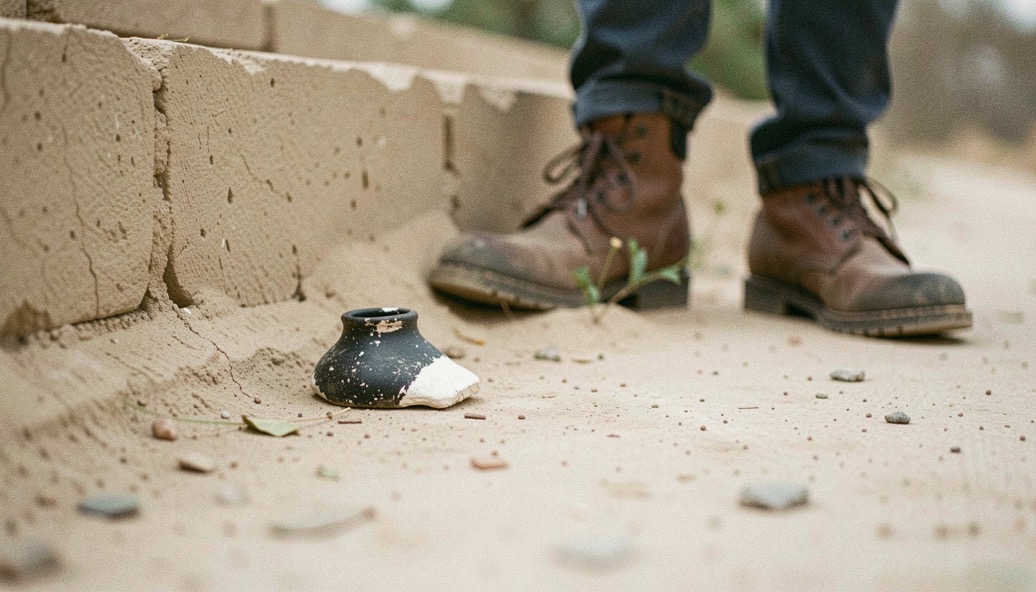
The Southwest is generous with its surface archaeology. Ruins shed pottery the way rivers shed gravel, and on any open site you will find sherds, chipped stone, maybe a corncob fragment, sitting exactly where centuries left them. Most visitors never learn what this generosity asks in return, and agencies spend real money teaching a rule that costs nothing: every artifact stays where it lies. This guide explains what a sherd is worth in place, how to observe one like an archaeologist, and what the law does to people who collect, because the collecting habit has already cost the region most of its undisturbed sites.
Why the context is the treasure
A sherd in a museum drawer is a date and a style. A sherd on its site is a date, a style, a household, a trade route and a moment, all at once. Context is the word for that bundle: the sherd's position, its companions, its depth, its association with a room, a midden or a trail. Move it and the bundle is gone; the object survives, the evidence does not. That asymmetry explains the whole ethic. A collector enriches a shelf; a site, once picked, is a book with every other page torn out. It also explains the science: surface distributions tell archaeologists where kitchens, workshops and fields were, and every removed sherd punches a hole in that map. The habit that replaces collecting is recording, and it is described below in a form anyone can keep on a phone.
What one sherd can tell you
Read the object where it lies, without turning it over. Paste color at the broken edge puts it in a ware family, and the table in our pottery types guide will usually date it to a period. Paint chemistry, mineral versus organic, narrows the tradition. Corrugation places it as a cooking jar; a polished black-on-white slip marks a serving bowl. Size hints at function, and a rim sherd, where available, can give the vessel's full profile. You are reading a broken pot, but you are also reading a household's week: what they cooked, what they served, what they traded for. The reading gets easier fast, because the Southwest repeats itself: after a month of museum cases, most hikers can sort a plain cooking jar fragment from a painted bowl rim at a glance, and the habit costs nothing but attention. That reading is the pleasure collecting promises and cannot deliver.
| Response | What it involves | What it costs | Where it stands |
|---|---|---|---|
| Take it | pocketing the sherd for a shelf or a sale | destroys context; on federal and tribal land a crime under ARPA, with real fines and jail time | never lawful on public land, never right anywhere |
| Move it | rearranging, stacking, "saving" it from the trail | breaks the surface record that maps the site | harmful even with kind intentions |
| Record it | photo, note, report to the land manager or steward program | nothing but attention | the whole duty of a careful visitor |
The observation habit, step by step
- Stop walking first; most sherd damage is a heel, and most finds are beside the trail, not on it.
- Photograph in place with something for scale, a coin, a lens cap, your folded map corner.
- Note the setting with rough tools: canyon, aspect, distance to the nearest wall stones.
- Name what you can from the types guide and admit what you cannot; honest unknowns help stewards.
- Report the find to the managing agency or the site steward program, and let them decide what needs a visit.
- Tell one other person the rule; every collected site was emptied by people who did not know better.
Mistakes to avoid with surface finds
Do not believe the surface collecting myth, the confident claim that arrowheads and sherds on public land are free for the taking; the law is printed plainly in our antiquities guide, and surface collection of archaeological material on federal land is prohibited, arrowheads included. Do not post exact find locations online; a photographed sherd with coordinates is a target list for night diggers, who are the reason fences exist at places that never needed them before. Do not clean, scratch or test fire a piece to identify it, and do not accept "it was just going to wash away" as an excuse, since that argument empties every site ever discovered. On private land, the owner may do as they wish; your job is to ask first and record anyway.
The decision, in one sentence
Look, record, leave, report: four verbs that cost nothing, keep every site's story whole, and quietly make you the kind of visitor agencies want more of, the kind the site steward programs were built to train. The Southwest has already lost most of its undisturbed places to pockets. Leave the next sherd where it lies, and you have done more for the archaeology than any museum gift shop ever will.