Rock Art & Petroglyphs
Reading rock art without overreading it
Every gift shop sells a decoder ring for rock art, and every professional archaeologist will tell you the decoder ring is wrong. Here is what careful reading looks like, from confident ground to honest unknowing.
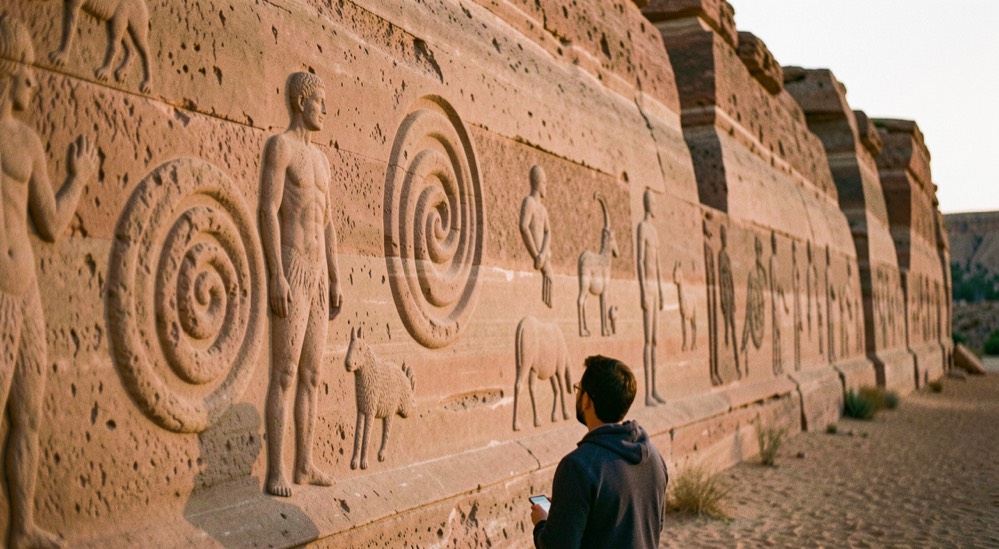
Rock art invites meaning the way a night sky invites constellations. The eye finds a spiral and wants a sentence. The honest position of modern rock art research is harder and better: some readings rest on strong convergent evidence, many are plausible guesses, and most of the great symbolic questions remain open, with the descendant communities holding interpretive authority that outsiders do not. This guide gives the traveler a defensible way to read, panel by panel, and names the common symbols together with what is actually claimed about them.
Why there is no dictionary
Three facts block the decoder ring. First, rock art spans millennia and cultures: a spiral pecked by a Basketmaker family and one painted by a Pueblo IV ceremony belong to different worlds, and a Fremont panel is another country altogether. Second, much Southwestern imagery is plausibly tied to ceremony, vision and clan history, domains whose meanings are held, not published, and whose public decoding would itself be a taking. Third, the makers left no Rosetta stone. Where translation does inform interpretation, it comes from living Pueblo and other tribal commentary, offered or withheld by choice. Respect for that authority is not a courtesy layer over the science; it is part of the method, and it parallels the etiquette owed at sites described in our visit checklist.
What can be said with confidence
Some claims rest on convergence strong enough to teach. Calendrical function is documented where light and shadow strike marked spirals at solstices, as at sites studied for decades in the Northern Southwest, and where ethnography and repetition agree. Hunting and subsistence imagery appears where bighorn, deer and atlatl figures cluster in economically sensible places, though whether the scene is narrative, prayer or something else remains open. Trail and place marking is supported where panels line routes, water and boundaries. Superposition and repatination establish sequence, and distinct style provinces correlate with known cultural territories, which is why a panel can be attributed even when no one can say what it says.
| Motif | Frequency and range | What scholarship defensibly says | What remains open |
|---|---|---|---|
| Spiral | everywhere, all periods | some examples function solsticially; migration symbolism argued from later Pueblo belief | whether any given spiral is calendar, map, vision or play |
| Bighorn sheep | Plateau and desert canyons | hunting magic and subsistence readings supported by context | individual panel intent; ceremonial roles |
| Anthropomorph | style defining regionally | costume, gender and pose read comparatively; shamanic readings argued | identity of figures and any specific story |
| Handprints and hand outlines | pan Southwest | plausibly ritual presence, marking, apprenticeship | age, status and meaning of the maker |
| Concentric circles and grids | common on borders | possibly map like or game related readings | almost everything, and saying so is the correct reading |
Method: how a careful reader works a panel
Do what the professionals do, in order. Record setting first: aspect, water, slope and sightlines, because context carries half the evidence. Read technique and superposition to build the panel's internal chronology, as the technique primer explains. Compare within the region, not across it, and let the strongest interpretations be the ones where context, ethnography and repetition point the same way. Then stop. The discipline of stopping is what separates reading from projection, and it is also where the deep satisfaction of rock art actually begins, because a panel that keeps some silence after a century of study is telling you something true about the distance between worlds.
Mistakes to avoid in interpretation
The overreading failures form a canon. Do not transcribe panels as if the images were sentences; the claim of a universal alphabet has been tested and has failed, publicly. Do not assign astronomical meaning to every circle; some are calendars, some are circles. Do not import meanings wholesale from unrelated continents, the drumbeat of most bad guidebooks. Do not announce spirit war or catastrophe narratives from single panels; drama is the cheapest thing a viewer can add. Do not publish precise locations of undamaged panels on public maps; location disclosure is the leading cause of new damage, whatever your intentions. And never treat descendant communities' beliefs as data you may grade. If a Pueblo reader tells you a panel is ceremonial and private, that is the interpretation, full stop, whatever the ceramics say.
The decision to carry into the canyon
Choose the method over the mnemonic. Read context, technique and comparison, hold the confident conclusions loosely, let the open questions stay open, and give the living communities the final word they are entitled to. You will come away with fewer certainties than the gift shop promises and more understanding than it can sell, and the panels, which is the point, will still be there, unimproved by you, for the next century of careful readers trained by guides like our starter reading list.