Rock Art & Petroglyphs
Petroglyphs and pictographs: a primer
Rock art is the Southwest’s oldest surviving graphic art, and it divides cleanly by technique: cut into stone or painted on it. Technique is also the honest place to start, because it dates, attributes and protects the panels.
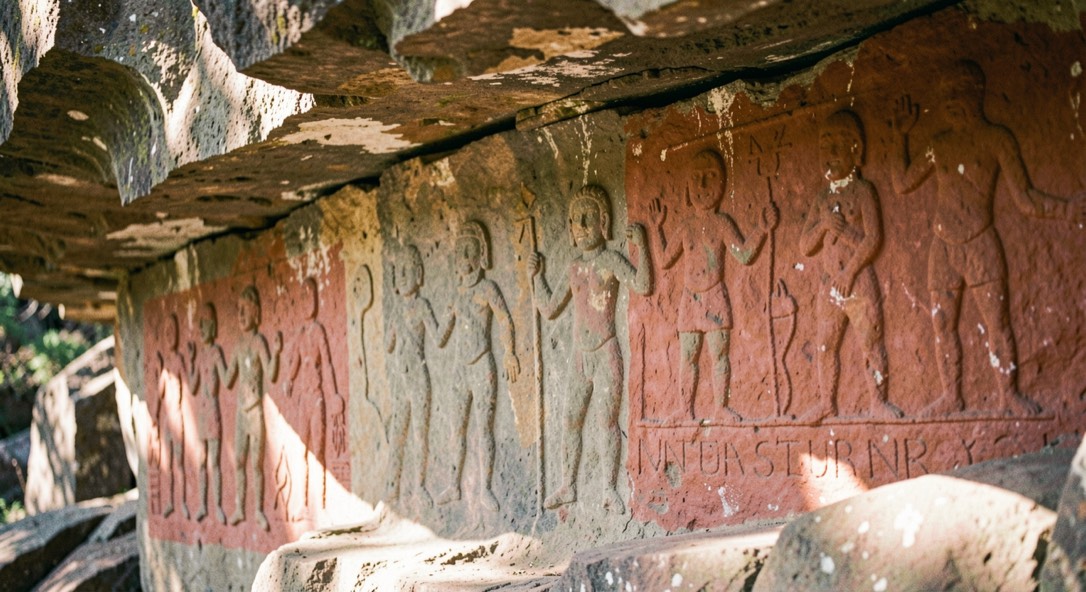
The Southwest holds one of the great bodies of rock art on earth: thousands of panels across Arizona, New Mexico, Utah, Colorado and Texas, some older than agriculture, some within living memory. Everything on this site's rock art stratum rests on one first distinction, the one in the field's oldest joke about not calling every image a hieroglyph. Petroglyphs are made by removing the stone's surface. Pictographs are made by adding pigment to it. The difference sounds pedantic until you realize that technique carries dating, preservation problems and cultural meaning all at once.
The workshop: how petroglyphs are made
A petroglyph is an exercise in patience with a hammerstone. Most Southwestern panels were produced by direct percussion, striking the rock with a harder stone to break through the dark desert varnish and expose the lighter grain beneath. Variants matter to a careful viewer: incising cuts thin lines with a sharp stone, abrasion rubs the surface with a stone blank, and some figures combine techniques. The varnish itself is the quiet hero. It grows at a rate of microns per millennium as clay and oxides fix to the rock face, so a pecked line that has re-varnished dark is old, and a bright raw scar is recent. That fact is both a dating tool and a moral one: every new scratch on a panel will sit there for centuries, a rule with legal teeth described in our antiquities laws guide.
The palette: how pictographs survive at all
Pictographs are paintings, and the Southwest's aridity is the only reason you can still see them. Pigments came from minerals ground on stone: iron oxides for reds and yellows, manganese for black, carbon or soot for blacks, and mineral bound binders such as plant sap, animal fat or even urine in some documented recipes. Paint was applied with brushes of fiber, chewed sticks or fingers, sometimes at the end of a blowpipe for the dot patterns. Because pigment sits on the surface, pictographs shelter under overhangs and in caves, and they fade, flake and suffer from touch more than any petroglyph ever will. The oil in one handprint starts chemistry the panel cannot reverse, which is why the visit rule is look, never lean.
| Technique | Tool and material | Typical look | Where it survives best |
|---|---|---|---|
| Percussion petroglyph | hammerstone on varnished rock | deep patinated outlines and bodies | open boulder faces and canyon walls |
| Incised petroglyph | sharp stone drawn in grooves | thin crisp lines, meanders and grids | sheltered smooth slabs |
| Abraded petroglyph | stone rubbed as a file | shallow polished cups and grooves | basalt and hard sandstone |
| Pictograph, mineral paint | ground hematite, manganese, binders | reds, yellows, blacks under overhangs | dry alcoves and caves |
| Pictograph, carbon paint | soot and charcoal mixes | matte black figures, sometimes dated by carbon testing | deep shelter interiors |
Style regions and their makers
Technique rides on style, and style maps onto culture loosely enough to require humility but tightly enough to be useful. The recognizably different provinces a traveler meets include Fremont and Ancestral Puebloan work on the Colorado Plateau, the Jornada and Mogollon styles of the south that fed into Rio Grande rock art, Sinagua panels around the Verde Valley, and the Hohokam and Patayan traditions of the southern deserts and the lower Colorado. The great anthropomorphic and bighorn panels of the San Juan drainage, the shield figures of the Pecos style in the Texas Trans Pecos and the mask heavy pictographs of the Hueco Mountains each belong to their own conversation. Our guide to the major rock art sites routes the public ones.
A field checklist for reading technique
- Identify first whether the image is cut in or painted on, and say so in your notes before interpreting anything.
- Check the repatination: darker lines in a petroglyph mean age, bright scars mean recent damage.
- Look for superposition, one figure over another, which orders the panel in time like layers in a midden.
- Photograph flat on, in raking light or with polarizing tricks, and never with chalk, water or touching.
- Record location and condition for the site steward or agency, not for your own map of secret spots.
Mistakes to avoid with technique talk
Do not call the images "writing" for a dictionary they are not, a habit our guide on reading rock art without overreading takes apart in detail. Do not date a panel by the subject, since horse figures prove contact era work but deer prove nothing earlier. Do not assume one technique means one people; techniques spread, and borderlands mix. Do not wet a petroglyph for a better photograph, a practice that accelerates salt damage, and do not make rubbings or casts, which are destructive and, on federal land, criminal. The gravest error is treating a bright initial or date scratched beside a panel as harmless; it is the same act as the vandalism cases the courts have fined and jailed people for, at scales the courts did not expect.
The decision to carry to the panel
Start every rock art encounter with technique and let meaning wait its turn. You will see more, because craft attention slows the eye where awe alone skims, and you will behave better, because understanding how varnish grows and pigment flakes makes the no touch rule feel like physics rather than bureaucracy. Read technique, read superposition, read condition, and leave the panel exactly as legible for the next visitor as you found it, which is the only interpretation this notebook treats as mandatory.