Iconic Sites
Chaco Canyon: reading the great houses
Chaco is the Southwest at its most architectural and its most argumentative. A century of research has dated the walls precisely and still cannot agree on what the whole machine was for, which is exactly why it rewards a prepared visit.
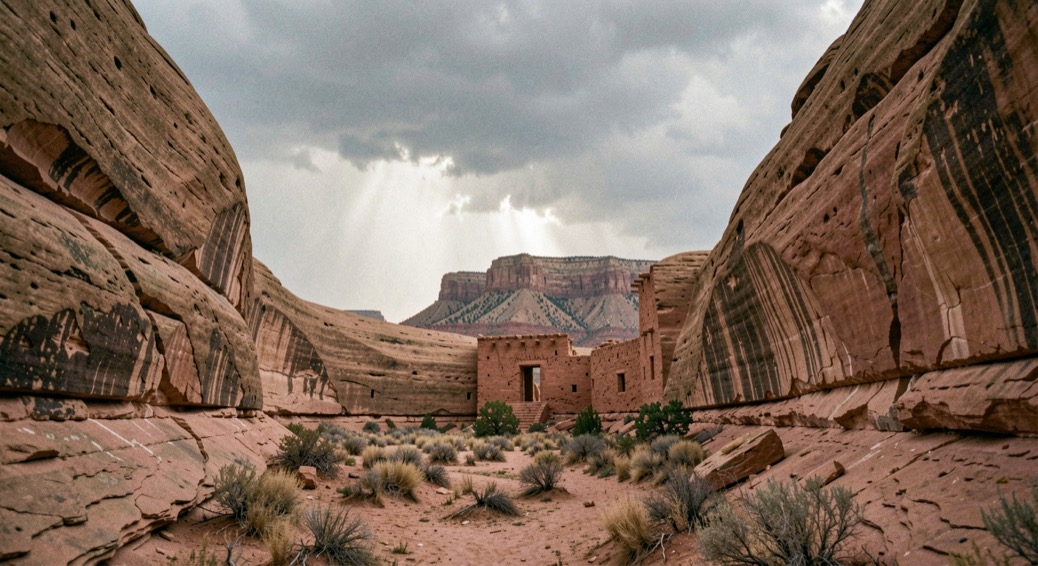
Chaco Canyon holds the densest cluster of great architecture in the ancient United States, and it does so in a place that looks like a dare: a dry, wide, treeless canyon on the Colorado Plateau, hours of pavement from anywhere. Between about 850 and 1150 CE, people we now count as Ancestral Puebloans raised masonry buildings of a scale and precision nothing else in the region matches, cut straight roads toward the horizon, and then walked away, leaving archaeologists a hundred year argument about purpose. The canyon is now the heart of Chaco Culture National Historical Park, a UNESCO World Heritage site, and it repays more preparation than any other ruin in the Southwest.
What a great house is
The great houses are planned, monumental, multistory buildings of carefully shaped sandstone. Pueblo Bonito, the largest, covers over two acres in a precise arc, rose four and sometimes five stories, and held more than six hundred rooms, though most were storage or ritual space rather than homes. Chetro Ketl across the plaza approach contains an estimated five hundred rooms and one of the largest great kivas ever built. The walls show Chaco's technical signature: courses of thin tabular sandstone faced with chips, thickened at the base, straight enough to embarrass some modern masonry. Wood for six hundred thousand or more beams came from mountains fifty miles and more away, hauled without wheels or draft animals, which tells you the labor budget was social, not local.
| Building | Main period | Scale | What to look for |
|---|---|---|---|
| Pueblo Bonito | about 850 to 1120s | D shaped, over 600 rooms, 4 to 5 stories | the blocked rear row, kiva density, the split by the fallen threat rock |
| Chetro Ketl | about 990 to 1070s | roughly 500 rooms, one great kiva | colononnade facade, plaster, the great kiva's scale |
| Casa Rinconada | about 1070s | great kiva about 19 meters across | bench, pilasters, the two aligned wall niches |
| Peñasco Blanco | about 900s onward | great house on the mesa top | the supernova pictograph record on the trail |
| Una Vida | about 850s onward | earliest great house phase, unrestored | its raw state, the clearest view of growth over time |
Roads, kivas and the question of purpose
Chaco is more than its buildings. Aerial survey and ground truthing have traced straight roads, some estimated at thirty feet wide, running for miles from outlying great houses toward the canyon, and more than a hundred and fifty related great houses across a region the size of a small country. Great kivas, giant round ceremonial chambers, anchor the plazas. This is where the argument lives. One school reads Chaco as a pilgrimage center: mostly empty for daily life, filling with processions, feast labor and ritual, its storage rooms holding the maize and turquoise that made the journey worthwhile. Another reads a political hierarchy, an elite directing labor and exchange. The residence question matters too: many great houses show surprisingly few domestic features, and the ordinary houses across the road at Pueblo del Arroyo's neighbors, the small sites near Casa Rinconada, held the everyday life. The honest position is that Chaco changed over three centuries, and both readings are probably true of different moments. Our Pecos timeline guide places that sequence in its Pueblo II frame.
The astronomy adds spice without closing the case. Buildings and kivas show alignments on cardinal directions, the sun standstills and the lunar cycle, and the pictograph near Peñasco Blanco, a crescent, a star and a hand, is famously argued as a record of the 1054 supernova. Evidence of intention is strong; the meaning is where humility starts.
A day in the canyon, done right
Chaco sits at the end of long dirt roads that turn to gum after rain, so check conditions with the park the morning you go. The Canyon Loop Drive links the great houses with short walks; Pueblo Bonito's wall-shadow trail is the essential one. Water is yours to carry, shade is scarce, and the elevation sits above six thousand feet. Camp at Gallo if you can, because the night sky program is not decoration: Chaco is a certified dark sky park, and the astronomy that may have organized the place is overhead after dinner, free.
- Call or check the park site for road status; do not attempt clay sections in a rental after storms.
- Carry more water than any other Southwest day trip of your life, a gallon per person in warm months.
- Walk the Pueblo Bonito trail with the wall guide sheet; it labels the growth stages better than memory will.
- Visit Pueblo del Arroyo and the Casa Rinconada small sites to see ordinary housing against the great houses.
- Respect closures: some rooms and sites close for tribal reasons and stabilization, and the closures are law, not suggestion.
Mistakes to avoid at Chaco
Do not try Chaco as a two hour detour; the roads deserve the day, and the canyon punishes rush. Do not describe it as a city; the resident population was modest, and the emptiness is data, not neglect. Do not climb the walls, pocket a sherd or walk off trail, because what is at stake is covered plainly in our guide to the antiquities laws. Do not repeat the ancient astronaut talk; the masonry is human, the beams are tree ring dated, and the achievement loses nothing by being real. And do not leave before dark if you can help it: half of Chaco's argument was written on the sky, and the migration that followed its decline reads differently under the same stars.
Decide what kind of visit you are making
Choose between two honest itineraries. The pilgrim version: drive the loop, sit in Pueblo Bonito's plaza, attend the evening astronomy program, and leave interpretation to wonder. The surveyor version: read the park's site bulletin first, walk the Peñasco Blanco trail for the pictograph, and compare masonry stages wall by wall. Both are correct; mixing them in one rushed afternoon is the only failure mode. Chaco rewards whichever discipline you bring, and it never forgives the absence of water.